
Marian Court Phases 3 & 4: Proposed Amendments to the Approved Development
Overview
Hackney Council is inviting your views on proposed changes to the approved Marian Court development.
Planning permission was granted in 2020 and remains valid. Before construction begins, the Council is proposing to amend parts of the approved design. This page explains what has already been approved, what changes are being proposed, and how you can share your views.
You can also view information from the previous engagement on the Marian Court proposals on the Council’s consultation platform here.
What has already been approved?
In 2020, planning permission was granted for:
- 160 new homes
- A mix of social rent, shared ownership and other tenures
- New public routes and open space
- Commercial space
- A new community facility
- Buildings of agreed heights and layout across the site
The principle of redevelopment, the overall layout and much of the building form have already been established through that permission.
Why are changes being proposed?
- New building safety and fire regulations under the Building Safety Act
- Updated building regulations
- Increased construction costs and associated viability pressures
These changes mean that refinements to elements of the approved scheme are now required before work starts on site. As a result, planning applications are being prepared to amend parts of the existing permission.
What is being proposed?
Hackney Council is preparing planning applications to amend specific elements of the previously approved Marian Court Phases 3 and 4 scheme.
These include a Section 73 application to amend defined parts of the approved design, and a Section 96a application to make minor changes to the scheme description. Both processes are explained in more detail below.
The overall principle of development remains unchanged. The proposed amendments relate to specific buildings and uses within the site.
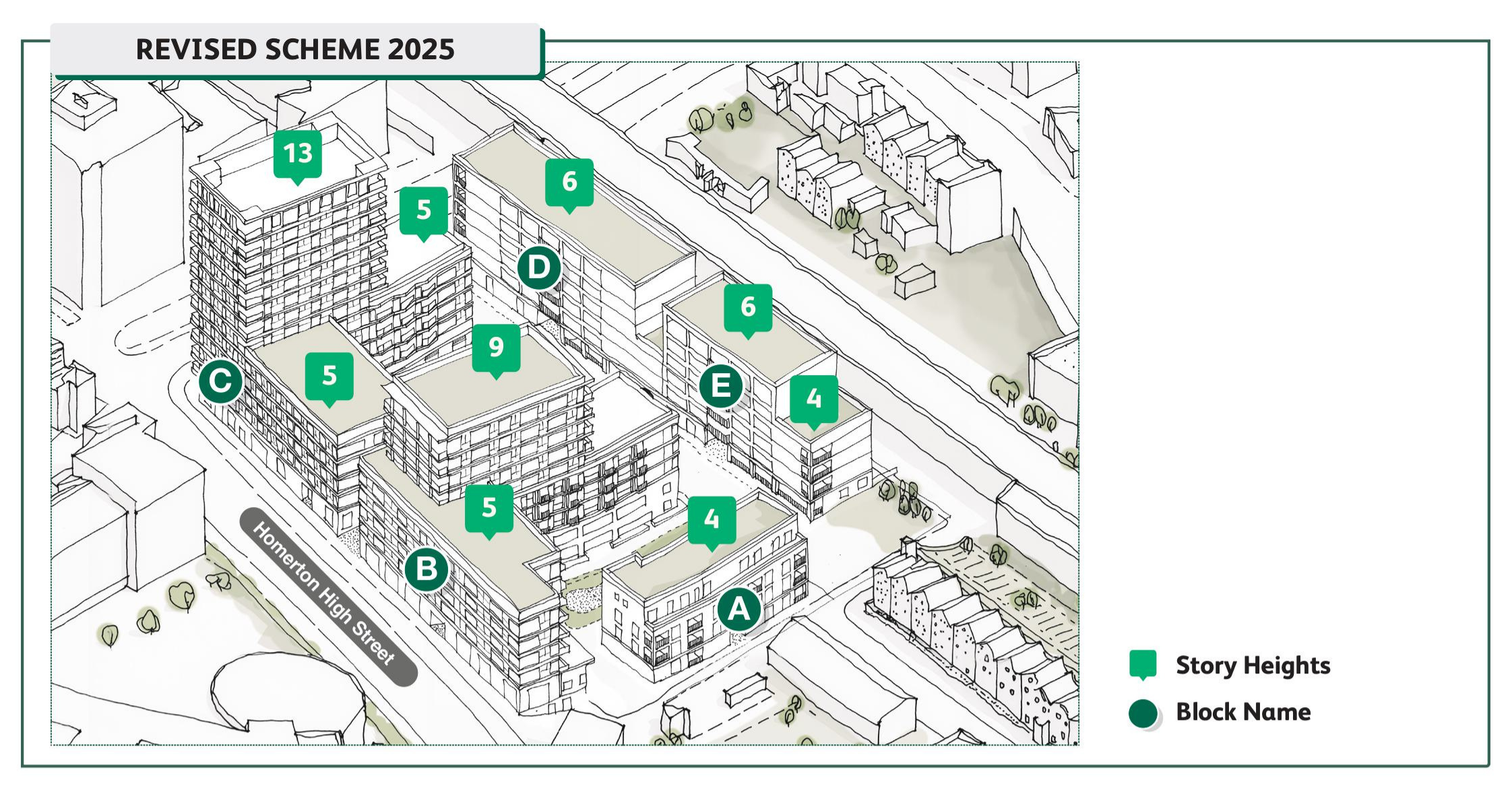
Summary of proposed amendments
- A slight increase in the total number of homes (from 160 to 163)
- An increase in social rent homes (from 32 to 36 within the overall mix)
- Design changes across the scheme in response to updated building safety and fire regulations
- Design updates to accommodate a revised energy strategy, including the introduction of air source heat pumps
- Replacement of the previously approved six townhouses in Block A with twelve flats
- A reduction in the amount of commercial space
- Relocation of the community space within the site
The images below show how the revised scheme compares to the previously approved scheme, including where plan area or mass has been added or removed.
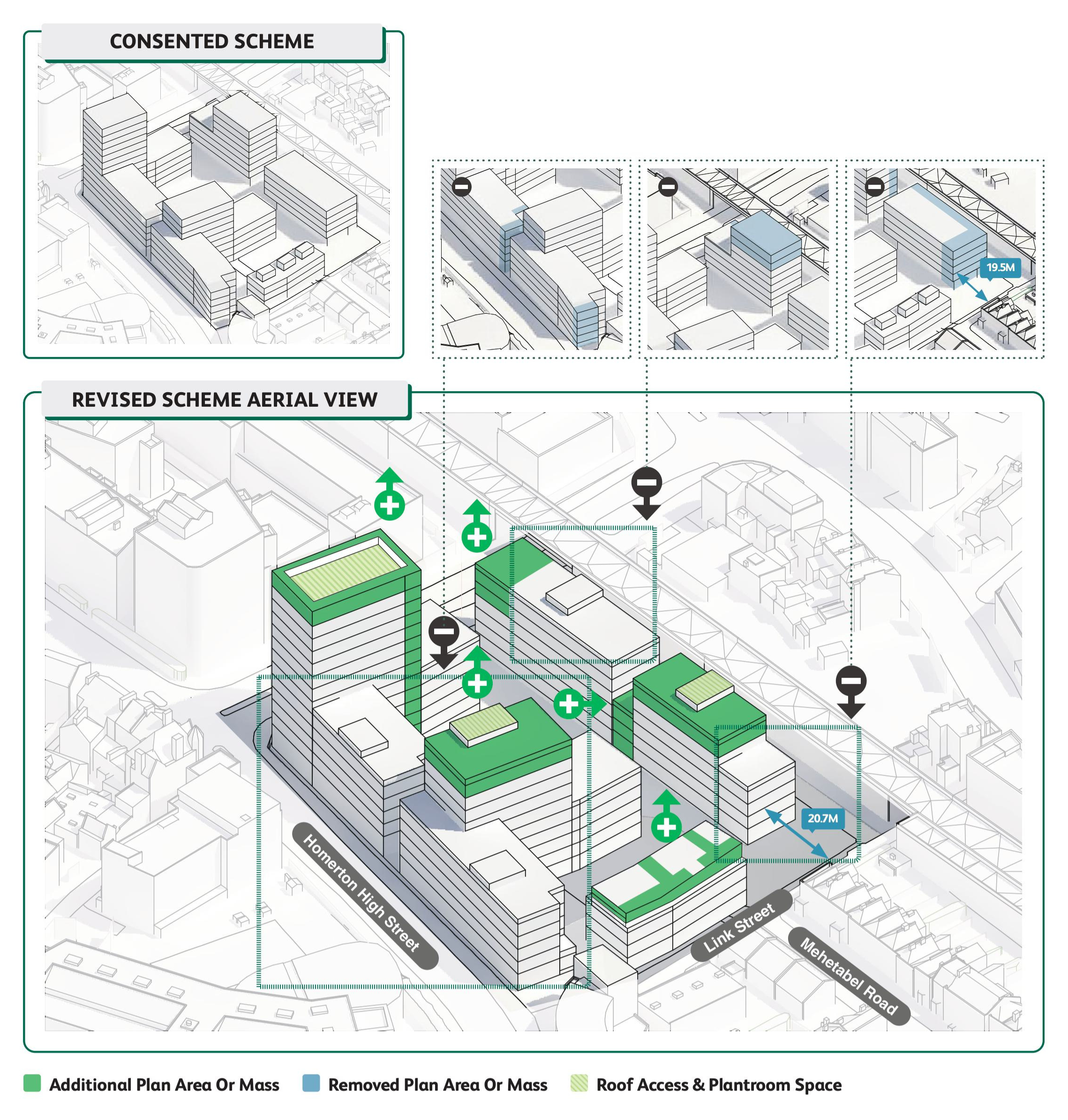
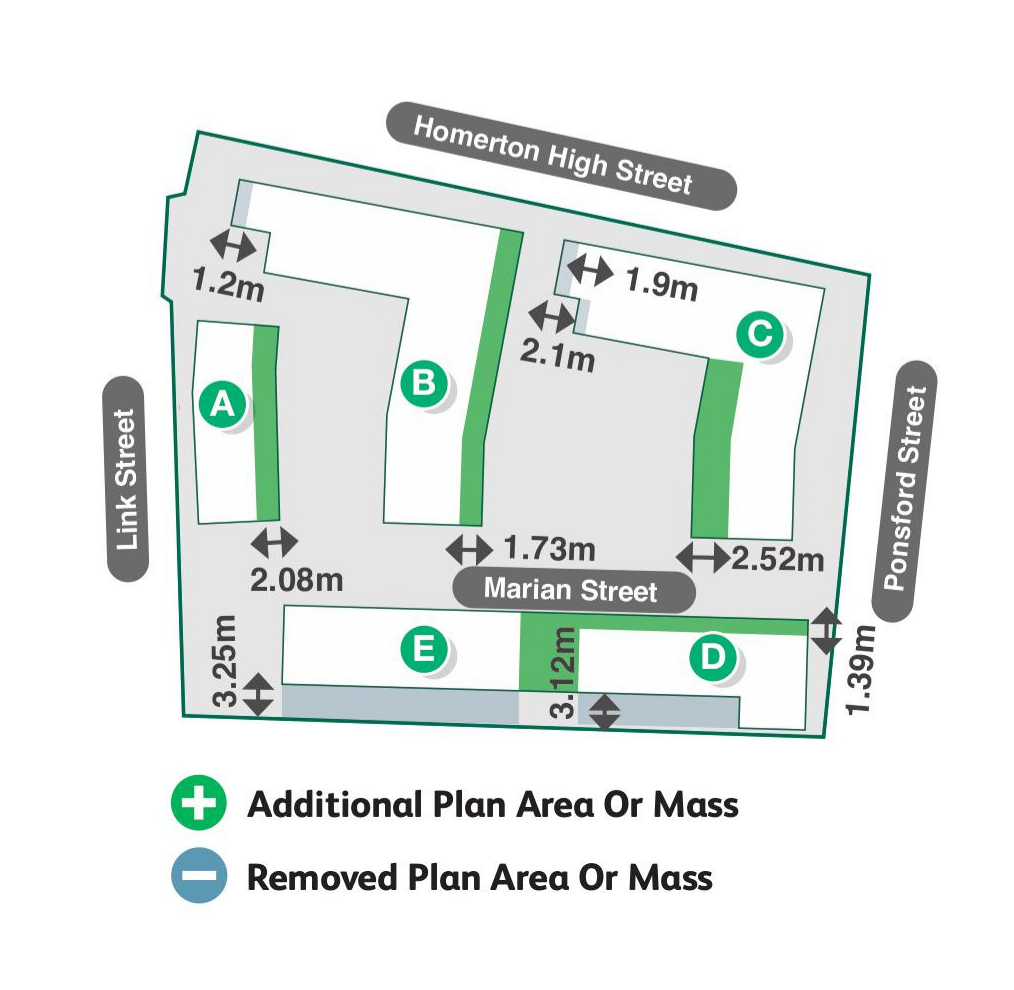
The plan diagram below provides additional detail on where plan area or mass is proposed to be added or removed across the site.
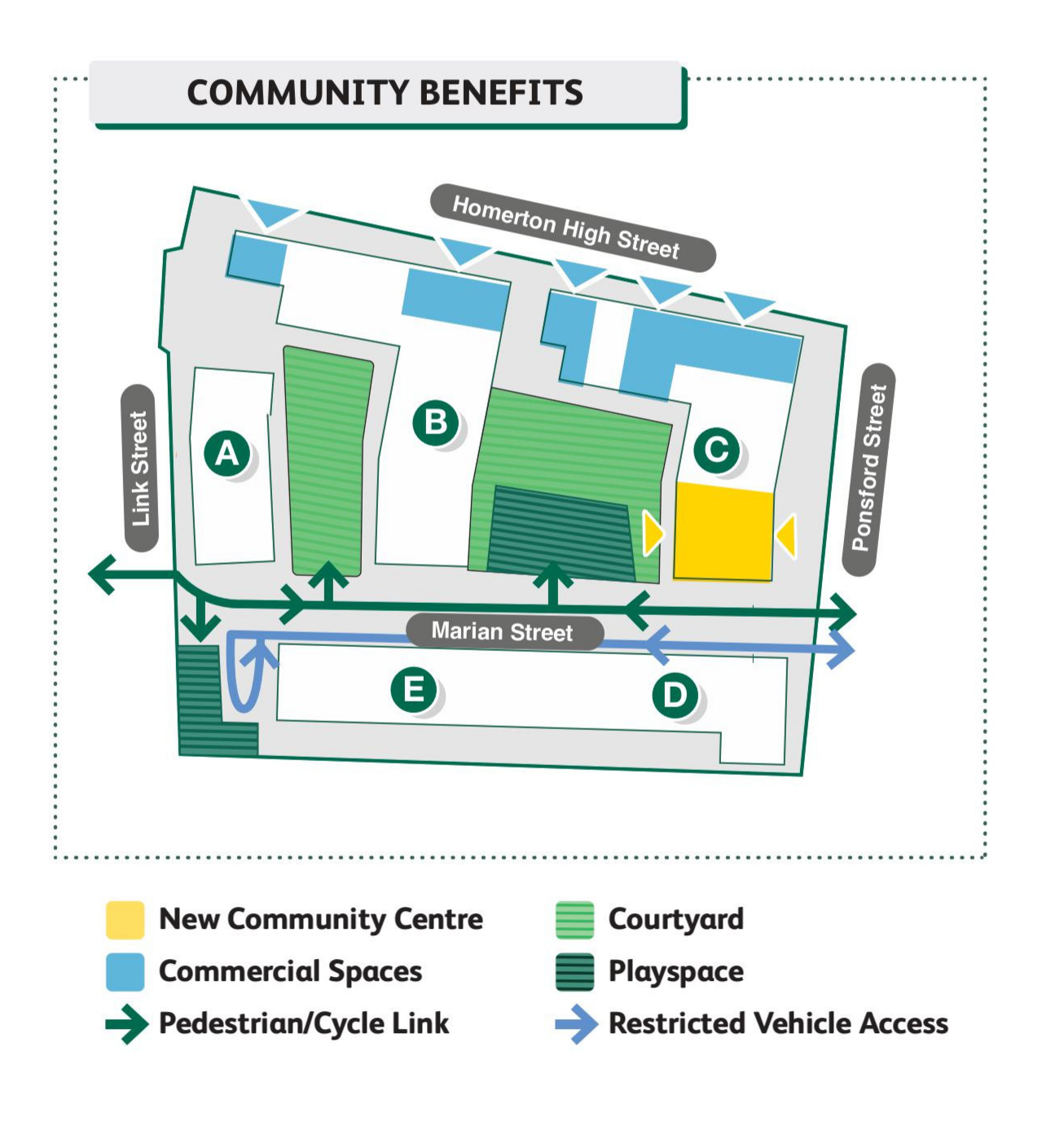
The proposed scheme also includes a community centre, commercial spaces, courtyards, a playspace and improved pedestrian and cycle links.
What planning applications are required?
Two types of planning application are being progressed:
Section 96a application
A Section 96a application allows minor changes to be made to the wording of an existing planning permission. These changes must be non-material, meaning they do not significantly alter what was originally approved.
This application does not involve physical changes to the development and does not change the amount of development permitted.
The local planning authority determines whether proposed changes are non-material. Section 96a applications are not usually subject to public consultation but will appear on Hackney’s online planning register.
Section 73 application
A Section 73 application allows defined elements of an approved scheme to be amended. It does not replace the original planning permission and does not reopen the entire development for reconsideration.
- The overall principle of development is not being reconsidered
- The general layout and planning framework remain in place
- Only the specific amendments applied for can be considered
If submitted, the Section 73 application will go through a formal statutory planning consultation. During that period, representations can be made directly to the Council’s Planning Service.
What can this consultation influence?
Your feedback may inform:
- Refinements to specific design elements
- Detailed layout or façade adjustments where feasible
- How changes are explained and presented
- Mitigation measures where appropriate
However, certain aspects are constrained by:
- Building regulations and safety requirements
- Funding and viability requirements
- The scope of what can legally be amended through Section 73
- The principles already established in the 2020 permission
This means the scope for change is limited to specific elements of the approved scheme.
Frequently Asked Questions
Is the amended scheme in line with planning policy?
The Council considers that the amended scheme can be progressed in line with relevant national, London-wide and local planning policy. This includes policies relating to design quality, development in well-connected locations, and updated building regulations, including fire safety requirements.
Why are you submitting two types of planning applications?
Updated building regulations and increased construction costs mean that refinements to the approved scheme are required. This involves two separate planning processes:
- A Section 96a application, which makes non-material changes to the wording of the existing planning permission.
- A Section 73 application, which seeks approval for defined amendments to elements of the approved design.
The two applications are determined separately under different legal procedures.
What is a Section 96a application?
A Section 96a application refers to Section 96a of the Town and Country Planning Act 1990. It allows non-material changes to an existing planning permission. The local planning authority determines whether proposed changes are non-material. These changes do not alter the amount of development permitted and are not usually subject to public consultation, although the application will appear on Hackney’s online planning register.
Can I comment on the Section 96a application?
Section 96a applications are not usually subject to public consultation because they relate to non-material changes. The application will appear on Hackney’s online planning register, and the local planning authority can be contacted about it.
What is a Section 73 application?
A Section 73 application allows defined elements of an approved scheme to be amended. It does not replace the original permission or reopen the entire development for reconsideration. If submitted, it will go through a formal statutory planning consultation, during which representations can be made directly to the Council’s Planning Service.
Why is this not a completely new planning application?
Planning permission for Marian Court Phases 3 and 4 was granted in 2020 and remains valid. The proposed changes relate to specific elements of the approved scheme. Section 73 provides a legal route to consider defined amendments without reopening the entire development for reconsideration.
What can the Section 73 application change?
A Section 73 application can only consider the specific amendments applied for. The overall principle of development is not being reconsidered, and the general layout and planning framework established in 2020 remain in place. This means not all aspects of the scheme are open to change through this process.
How much larger is the amended scheme?
The amended scheme proposes 163 homes in total, compared with 160 homes in the approved 2020 scheme. This is an increase of three homes overall. Additional built form has mainly been required to accommodate updated fire safety requirements, including extra escape stairs, while some parts of the scheme have also reduced in height or footprint.
Will the number and type of homes change?
Yes. The proposed amendments include a small increase in the total number of homes and changes to the tenure mix. The amended scheme would provide 36 social rent homes, 61 shared ownership homes and 66 private homes. More detail is set out in the information on this page and in the consultation materials.
What guides the design of the amended scheme?
The design approach builds on the principles of the approved scheme, including creating new homes alongside new routes, public spaces and better connections through the site. The amended design has also had to respond to updated regulations, viability pressures and the need to deliver a high-quality scheme on a constrained urban site.
Are the heights of the buildings changing?
The 2020 planning permission established the overall approach to height and layout across the site. The proposed amendments include some changes to height and massing on specific blocks. These are shown in the drawings and visual material on this page and in the exhibition boards.
How has height and massing been assessed?
The amended scheme has been developed in the context of planning policy for well-connected urban locations, where higher-density development can be appropriate. The design has also been shaped by updated fire safety requirements, viability considerations, and the need to provide a workable and deliverable layout.
What about daylight and sunlight impacts?
The Council recognises that changes in height and density can affect daylight and sunlight to neighbouring properties. The amended scheme has been assessed against relevant guidance, including guidance used in London and more generally across the UK. Current work suggests that any additional impact beyond the approved scheme is generally limited and incremental. Summary information will be available through the consultation materials.
What about overlooking and privacy?
The design team has considered overlooking carefully as part of the amended scheme. Measures such as block positioning, balcony arrangement and internal layout have been used to help manage privacy impacts where possible, particularly in relation to private amenity spaces and neighbouring homes.
Is there a loss of permeability or accessibility through the site?
The scheme is intended to remain highly permeable, with multiple access and exit points through the site. The amended layout continues to include internal routes and connections linking surrounding streets and spaces.
Will there be fewer commercial units?
Yes. The amended scheme reduces the amount of commercial space and the number of commercial units. This reflects viability considerations and a desire to concentrate active frontages in stronger locations along the High Street. The Council has also considered management and safety issues linked to vacant or underused commercial space.
Are there changes to landscaping, play space and the community garden?
Yes. The amended scheme includes changes to the courtyards and play areas. Overall courtyard space has reduced, but planting is proposed to increase, including additional trees. The community centre will have a dedicated outdoor area within the courtyard landscape. The layout has also been adjusted so that the main play area in the larger courtyard is not affected by vehicle turning movements. The approved basketball court is not included in the amended proposals.
Has the sustainable drainage approach been reviewed?
Yes. The sustainable urban drainage approach has been reviewed as part of the amended design, including in response to lessons from earlier phases of the development. This has informed the updated landscape and drainage proposals.
Have lessons from Bridge House informed the amended scheme?
Yes. After Bridge House was completed, the Council carried out a post-occupancy evaluation and wider review of delivery. This highlighted areas such as drainage, cycle parking, and building management that could be improved, alongside positive feedback about the overall design and quality of homes. These lessons have helped inform the amended proposals.
Could the amended layout create antisocial behaviour issues?
The design team has considered safety and management issues as part of the revised scheme. This includes the treatment of routes, frontages and spaces across the site. The aim is to create a layout that is active, overlooked and easier to manage, rather than leaving hidden or poorly supervised areas.
Are the proposed materials changing?
Yes. Some material changes are proposed across the scheme. This includes the removal of tiling from Block D as part of the current amendments.
Will the relocated community space create noise for neighbouring residents?
The community space is proposed to be relocated within the site, with its main entrance from the courtyard side. The Council considers that the design and location provide appropriate mitigation, and that surrounding background noise from the wider area is also a relevant factor.
What consultation is being carried out on the amended scheme?
This engagement includes street exhibitions, door knocking, stakeholder meetings and an online survey and information page. Feedback from this process will help inform the final proposed amendments before any Section 73 application is submitted. An Addendum Statement of Community Involvement will then summarise the engagement and the issues raised.
What can this engagement influence?
Your feedback may inform refinements to specific design elements within the scope of the proposed amendments, how changes are explained and presented, and potential mitigation measures where appropriate. Some aspects are constrained by building safety requirements, planning rules, viability considerations and the limits of what can legally be amended through Section 73.
What happens after this engagement period?
Feedback received during this engagement period will be reviewed and captured in an Addendum Statement of Community Involvement. If a Section 73 application is submitted, a formal statutory planning consultation will take place, and residents will be able to make representations directly to the Council’s Planning Service.
Who makes the decision on these applications?
Planning applications are determined by the local planning authority in line with planning law and policy. Decisions are made through the formal planning process and are independent from the project team delivering the scheme.
Why your views matter
Before we submit the Section 73 application, we want to inform residents, businesses and local stakeholders about the proposed amendments and provide an opportunity to comment.
Complete the online survey at the end of this page.
Street exhibitions – speak directly with the project team
Come along to view the proposed amendments and speak with Council officers and design leads about the changes before the Section 73 application is submitted.
- 10am–1pm, Saturday 7 March
In front of the City Academy, Hackney - 2pm–5pm, Saturday 7 March
In the Bridge House courtyard - 4pm–7pm, Monday 9 March
At the junction of Mehetabel Road and Link Street
Information from the street pop-ups
The information boards displayed at the street pop-up events are available to view below. These boards explain the proposed amendments in more detail, including changes to the site layout, building heights, public realm, housing offer and street views.
- Board 1: Introduction
- Board 2: Summary of proposed changes, engagement and feedback
- Board 3: Changes in plan
- Board 4: Changes to height
- Board 5: Landscape, linkages and public realm
- Board 6: Community and housing benefits
- Board 7: Street views
- Connections sheet: Local linkages and walking routes
If you are unable to attend one of the street exhibitions, you can use these materials alongside the survey at the end of this page to review the proposals and share your views.
We will also be door knocking in the area on 27 and 28 February and 2 March, and meeting local resident groups, schools and other stakeholders to discuss the proposed amendments and gather feedback.
Next steps and timeline
This engagement period runs until 26 March 2026. During this time residents and stakeholders can review the proposed amendments and share feedback through the survey, street exhibitions and conversations with the project team.
After this engagement period closes, the Council will review the feedback received and prepare a summary of responses.
A further update will be shared with residents and businesses after the local elections in May to explain how feedback has been considered and how the proposals will be taken forward.
Subject to this process, the Council currently expects the Section 73 planning application to be submitted in spring/summer 2026.
Please review the information and images above before completing the questionnaire on the next page.
Interests
- Gathering ideas
- New Homes Programme
- Planning
- Regeneration
- Understanding views
Share
Share on Twitter Share on Facebook